Mobirise
Nanoreceptors

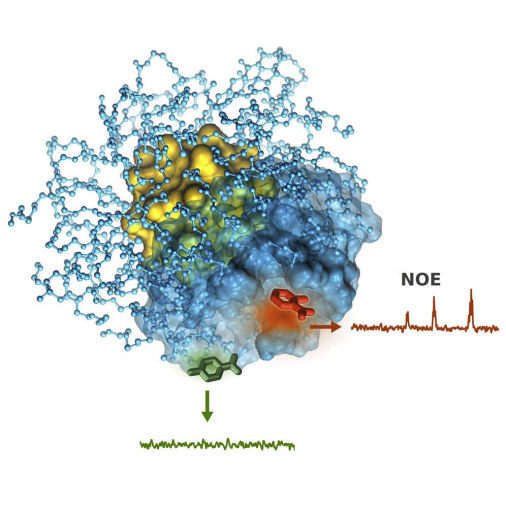
Nanoparticles coated with a shell of organic ligands are attractive and promising tools for the realization of artificial receptors based on self-organization and structural adaptation. The coating shell of ligands is indeed a partially flexible array of radially ordered organic molecules. With this arrangement, interacting points inserted into the ligands can be used for host-guest recognition. They are clustered and partially pre-organized by the grafting to the gold core. Still, they maintain enough flexibility for position adjustments and conformational reorganization upon guest binding. Rational design of nanoparticle coating monolayers have led over the years to understand the main parameters controlling affinity and selectivity. Computer-aided design can lead to a new generation of protein-like nanoreceptors.
For more details...

Mobirise

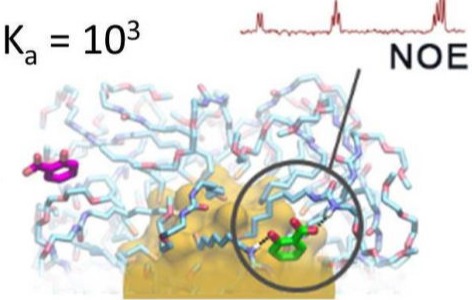
Here, we demonstrate the possibility of rationally designing nanoparticle receptors with targeted affinity and selectivity for specific small molecules. We used atomistic molecular‐dynamics (MD) simulations to gradually mutate and optimize the chemical structure of the molecules forming the coating monolayer of gold nanoparticles (1.7 nm gold‐core size). The MD‐directed design resulted in nanoreceptors with a 10‐fold improvement in affinity for the target analyte (salicylate) and a 100‐fold decrease of the detection limit by NMR‐chemosensing from the millimolar to the micromolar range. We could define the exact binding mode, which features prolonged contacts and deep penetration of the guest into the monolayer, as well as a distinct shape of the effective binding pockets characterized by exposed interacting points. Read more...

Mobirise

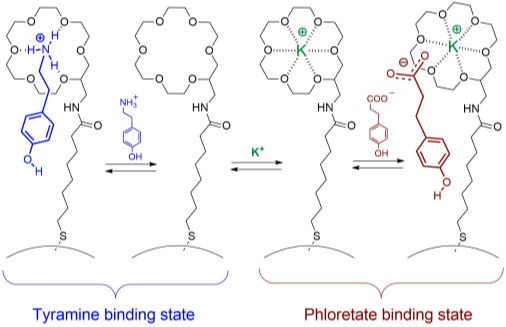
A sensing protocol to detect potassium ions in water by 1H NMR spectroscopy is described. The method exploits the K+‐modulated affinity of 18‐crown‐6 functionalized gold nanoparticles towards organic ions, combined with NOE magnetization transfer. Binding of K+ to the crown ether moieties switches the nanoreceptor preference (and its ability to transfer magnetization) from organic cations (tyramine) to organic anions (phloretate). In this way, a ratiometric NMR signal is produced with a detection limit of 0.6 mM. Detection can be performed in 20 min with standard instruments and with little interference from other alkali and alkaline earth metal ions present in the sample. Read more...

Mobirise

The self-assembly of a monolayer of ligands on the surface of noble-metal nanoparticles dictates the fundamental nanoparticle's behavior and its functionality. In this combined computational-experimental study, we analyze the structure, organization, and dynamics of functionalized coating thiols in monolayer-protected gold nanoparticles (AuNPs). We explain how functionalized coating thiols self-organize through a delicate and somehow counterintuitive balance of interactions within the monolayer itself and with the solvent. We further describe how the nature and plasticity of these interactions modulate nanoparticle-based chemosensing. Importantly, we found that self-organization of coating thiols can induce the formation of binding pockets in AuNPs. These transient cavities can accommodate small molecules, mimicking protein-ligand recognition, which could explain the selectivity and sensitivity observed for different organic analytes in NMR chemosensing experiments. Thus, our findings advocate for the rational design of tailored coating groups to form specific recognition binding sites on monolayer-protected AuNPs. Read more...

© Copyright 2020 Mobirise. All Rights Reserved.

Designed with Mobirise - Check it