Mobirise
Chemosensors

According to Czarnik, chemosensors are "molecules of abiotic origin that signal the presence of matter or energy". They can be considered as supramolecular receptors which undergo a change of a measurable physico-chemical property upon target recognition. We are interested in designing chemosensors were the self-organization of the components (binding unit, signalling unit) produces the sensing mechanism. Recently, we have been also investigating a new approach were the formation of the host-guest complexes allows the extraction of the spectral features of the analyte from those of the sample. Primarily applied to NMR using nanoparticle receptors, this approach allows the unambiguous identification even of unknown analytes.    
For more details...

Mobirise

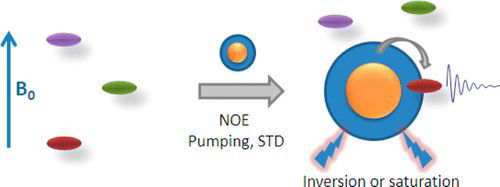
“Nanoparticle-assisted NMR chemosensing” combines magnetization transfer NMR techniques with the recognition abilities of gold nanoparticles (AuNPs) to isolate the NMR spectrum of relevant organic species in mixtures. The efficiency of the magnetization transfer is crucial to set the detection limit of the technique. To this aim, a second generation of nanoreceptors obtained by the self-organization of 2 nm AuNPs onto the surface of bigger silica nanoparticles shows better magnetization transfer performances, allowing the detection of analytes in water down to 10 μM concentration using standard instrumentation.

Mobirise

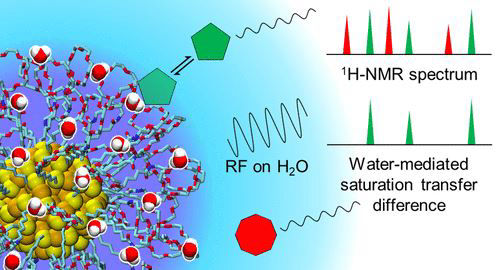
Nanoparticle-assisted “NMR chemosensing” is an experimental protocol that exploits the selective recognition abilities of nanoparticle receptors to detect and identify small molecules in complex mixtures by nuclear Overhauser effect magnetization transfer. Although the intrinsic sensitivity of the first reported protocols was modest, we have now found that water spins in long-lived association at the nanoparticle monolayer constitute an alternative source of magnetization that can deliver a remarkable boost of sensitivity, especially when combined with saturation transfer experiments. The approach is general and can be applied to analyte–nanoreceptor systems of different compositions. In this work, we provide an account of the new method and we propose a generalized procedure based on a joint water–nanoparticle saturation to further upgrade the sensitivity, which ultimately endows selective analyte detection down to the micromolar range on standard instrumentation.

Mobirise

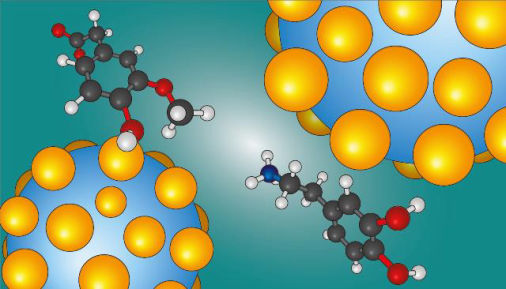
Properly designed monolayer-protected nanoparticles (2 nm core diameter) can be used as nanoreceptors for selective detection and identification of phenethylamine derivatives (designer drugs) in water. The molecular recognition mechanism is driven by the combination of electrostatic and hydrophobic interactions within the coating monolayer. Each nanoparticle can bind up to 30-40 analyte molecules. The affinity constants range from 10(5) to 10(6) M-1 and are modulated by the hydrophobicity of the aromatic moiety in the substrate. Detection of drug candidates (such as amphetamines and methamphetamines) is performed by using magnetization (NOE) or saturation (STD) transfer NMR experiments. In this way, the NMR spectrum of the drug is isolated from that of the mixture, allowing broad-class multianalyte detection and even identification of unknowns. The introduction of a dimethylsilane moiety in the coating monolayer allows performing STD experiments in complex mixtures. In this way, a detection limit of 30 M is reached with standard instruments.

Mobirise

By exploiting a magnetization transfer between monolayer-protected nanoparticles and interacting analytes, the NMR chemosensing protocol provides a general approach to convert supramolecular receptors into chemosensors via their conjugation with nanoparticles. In this context, the nanoparticles provide the supramolecular receptor not only with the “bulkiness” necessary for the NMR chemosensing approach but also with a different selectivity as compared to the parent receptor. We here demonstrate that gold nanoparticles of 1.8 nm core coated with a monolayer of 18-crown-6 ether derivatives can detect and identify protonated primary amines in methanol and in water, and even discriminate between two biogenic diamines that are selectively detected over monoamines and α-amino acids.

Mobirise

Monolayer-protected nanoparticles provide a straightforward access to self-organized receptors that selectively bind different substrates in water. Molecules featuring different kinds of noncovalent interactions (namely, hydrophobic, ion pairing, and metal-ligand coordination) can be grafted on the nanoparticle surface to provide tailored binding sites for virtually any class of substrate. Not only the selectivity but also the strength of these interactions can be modulated. Such recognition ability can be exploited with new sensing protocols, based on NMR magnetization transfer and diffusion-ordered spectroscopy (DOSY), to detect and identify organic molecules in complex mixtures.

Mobirise

A new sensing protocol based on NMR magnetization transfer sequences and the molecular recognition abilities of nanoparticles allows the detection and identification of organic molecules in complex mixtures.

© Copyright 2020 Mobirise. All Rights Reserved.

This site was created with Mobirise