
Design molecules patterns on the surface of nanoparticles
The concept of “molecular machines” has become common even in the everyday language to describe the ultimate achievements expected from chemical research. The term has gained a much broader significance than the original one and includes any molecular or nanoscopic entity capable to perform the highly sophisticated functions typical of macroscopic devices, ranging from controlled dislocation to transformation, delivery and information processing.
While chemical science is still striving in the search for such molecular machinery, real and perfectly working molecular machines have been developed millions of years ago by Nature. When the main characters at play in biological systems, such as proteins, nucleic acids, and membranes, are examined in detail, one striking feature that emerges is their intrinsic functional simplicity, since only a few building block are used to build complex structures. Apparently, what matters is not chemical complexity but the ability of precisely control the spatial arrangement and organization of simple building blocks.
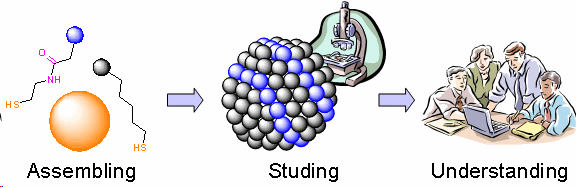
Functional nanoparticles, where a metal nanocluster is stabilized by a monolayer of organic molecules, offer unmatched opportunity to build complex structures with simple building blocks and relatively simple manipulations. The main goal of the Mosaic project is to gain the ability to hierarchically control the self-assembling of metal nanoparticles coating monolayers and take advantage from such ability to obtain complex function from the materials realized. This objective will require to reach a complete understanding of the structure and dynamic of nanoparticles coating monolayers developing new tools for their investigation. Then, we plan to learn how to use supramolecular interactions to control the monolayer organization and to gain, in this way, the ability to program functional groups patterns on the surface of the particles. In this way, it will possible to achieve a degree of organization comparable to that of biologic systems, such as enzymes or membranes. This organization of functional groups will be then used to obtain highly sophisticated function by these nanosystems, such as recognition, sensing, catalysis and transport.